How to Build a Therapy Website That Attracts Clients

A therapy website should do more than look professional. It should help someone understand whether your practice feels like a fit.
That may sound simple, but it is where many therapy websites fall short. Some look polished but feel vague. Some explain credentials but not the client experience. Some list services but do not make the next step clear. Others were built years ago and no longer reflect how the practice actually works.
For someone already unsure about reaching out, that matters.
Your website often shapes the first real impression of your practice. Even if a potential client finds you through Google, Psychology Today, a referral, or another directory, they may still visit your website before contacting you.
A strong therapy website helps them answer:
Do they work with people like me?
Do they understand what I am dealing with?
What kind of therapy do they offer?
Where are they located or licensed?
What happens if I reach out?
Does this feel like someone I could talk to?
The goal is not just to have a website. It is to have a website that reduces confusion, builds trust, and makes the next step easier.
What Makes a Good Therapy Website?
A good therapy website clearly explains who you help, what you help with, how you work, where you practice, and how someone can contact you.
It should include:
A clear homepage
An about page that builds trust
Service pages for your main specialties
Location or online therapy information
A contact or consultation page
Clear calls to action
Accurate credentials and licensing details
Mobile-friendly design
Basic SEO structure
Copy that sounds like your practice, not generic marketing
For a solo therapist, the site can be simple. For a group practice, it usually needs more structure. But in both cases, the website should help the right person understand the practice without having to work too hard.
Do Therapists Still Need a Website in 2026?
Yes, most therapists still benefit from having a website. But not every therapist needs a large or complicated one.
A therapy website is still useful because it gives potential clients a place to understand your practice outside of a directory profile, social media account, or referral conversation.
Even when someone hears your name from another therapist, doctor, friend, or Psychology Today, they may still search for your website before reaching out.
That matters because a website gives you more space to explain your services, approach, availability, location, and next steps.
A website does not replace referrals, directories, or word of mouth. It supports them.
If your website is clear, it can make reaching out feel easier. If it is outdated, vague, or hard to use, it can create hesitation before a consultation is ever booked.
Website vs. Psychology Today: Do Therapists Need Both?
Psychology Today and other therapist directories can still be useful. They can help people find you when they are actively comparing options.
But a directory profile is a rented visibility.
You are working inside someone else’s platform, layout, filters, and rules. Your profile appears beside many other therapists. You only have so much control over how your work is presented.
Your website is different.
It gives you more control over how your practice is explained, how your services are organized, and what potential clients see next.
A directory profile may help someone find you. Your website can help them understand you.
For many therapists, the strongest setup is not a website or a directory. It is both working together:
Your directory profile helps with discovery
Your website builds more trust and context
Your service pages support SEO and AI visibility
Your contact page makes the next step clear
If your directory profile gets views but few inquiries, your website may be where trust is breaking down.
What Your Therapy Website Needs to Communicate
Before thinking about colours, fonts, or layouts, get clear on what the site needs to say.
A therapy website should quickly communicate four things.
1. Who You Help
Potential clients should not have to guess whether your practice is for them.
Be clear about whether you work with adults, teens, children, couples, families, parents, professionals, students, or another group.
For example:
Therapy for adults dealing with anxiety and burnout
Couples therapy for partners stuck in repeating conflict
Online therapy for professionals across Ontario
Trauma therapy for adults who want a paced, grounded approach
This does not mean excluding everyone else aggressively. It means helping the right person recognize themselves.
2. What You Help With
Your website should name the concerns, experiences, or situations you support.
Avoid relying only on broad lists like anxiety, depression, trauma, stress, relationships, and self-esteem. Those terms may be accurate, but they often need more context.
For example:
Instead of only saying:
I work with anxiety.
You might explain:
I work with adults who look like they are managing everything from the outside, but internally feel tense, overwhelmed, or unable to fully rest.
That kind of language helps a potential client feel more understood.
3. How Therapy With You Works
Clients do not need a technical explanation of every modality you use.
They need to understand what therapy with you may feel like.
Are you structured? Reflective? Warm? Direct? Practical? Relational? Trauma-informed? Skills-based? Depth-oriented?
Explain your approach in plain language.
For example:
My approach is calm, collaborative, and practical. We will look at the patterns that keep showing up, while also building tools you can use outside of sessions.
4. What Happens Next
A potential client should never have to search for the next step.
Make it clear whether they should:
Book a consultation
Fill out a contact form
Email you
Join a waitlist
Contact your intake coordinator
Choose a therapist from your team
The next step does not have to be pushy. It just has to be obvious.
What Should a Therapy Website Include? 5 Essential Pages
Most therapy websites need at least five core pages.
1. Homepage
Your homepage should help someone quickly understand where they are and whether to keep reading.
A strong homepage usually includes:
A clear headline
A short explanation of who you help
A few service pathways
Location and online therapy information
A brief introduction to your approach
Trust markers such as credentials, associations, or experience
Clear calls to action
The homepage should not try to say everything. It should guide people toward the next useful page.
2. About Page
Your about page should build trust, but it should not read like a résumé.
Potential clients are usually trying to understand what it might feel like to work with you.
A strong therapist about page includes:
Who you work with
What informs your approach
What therapy with you may feel like
Your credentials and licensing information
A professional photo
A clear next step
If your about page feels too generic or too formal, it may not be doing enough to build trust.
You can read more about writing a strong therapist about page here: Therapist About Page Examples
3. Service Pages
Service pages help both people and search engines understand what you offer.
If a service is important to your practice, it usually deserves its own page.
Examples:
Anxiety Therapy in Toronto
Online Therapy in Ontario
Couples Therapy in Vancouver
Trauma Therapy for Adults
EMDR Therapy
Therapy for Burnout and Perfectionism
Each service page should explain:
Who the service is for
What the client may be experiencing
How therapy can help
Your approach
Location or online availability
What to do next
A single page that lists every service is usually too thin for SEO and too vague for clients.
4. FAQ or Getting Started Page
A getting started page can reduce uncertainty before someone reaches out.
It can answer questions like:
Are you accepting new clients?
Do you offer free consultations?
What are your fees?
Do you accept insurance?
Do you offer online therapy?
What happens after I submit the form?
How do I choose the right therapist on your team?
This page is especially useful for group practices or therapists with a more structured intake process.
5. Contact Page
Your contact page should be simple, clear, and reassuring.
Include:
Contact form or booking link
Email or phone number, if appropriate
Consultation details
Response time expectations
Location or virtual therapy information
Accessibility or parking details, if relevant
Current availability or waitlist information
For someone who has been debating whether to reach out, a confusing contact page can be enough to stop the process.
Where Your Website Copy Should Go
Each page on your therapy website has a different job. Rather than repeating the same information everywhere, organize your copy around what a potential client needs at each stage.
Homepage: Quickly explain who you help, your main services, where you work, and where someone should go next.
About page: Help potential clients understand who you are, how you work, and what it may feel like to work with you.
Service pages: Give each important service enough space to explain who it is for, what someone may be experiencing, how you can help, and what the next step is.
Contact page: Keep the copy simple and reassuring. Explain how to reach you and what happens after someone gets in touch.
Clear website copy is not about adding more words. It is about putting the right information in the right place so potential clients do not have to search for answers.
If putting your practice into words is the harder part, learn more about website copywriting for therapists.
Therapy Website Design Should Support Trust, Not Just Style
Design matters, but not because your website needs to look impressive.
Design matters because it shapes how easy your site is to use and how credible your practice feels.
A therapy website should feel calm, readable, and easy to move through.
Pay attention to:
Clear navigation
Readable font sizes
Enough spacing between sections
Mobile-friendly layout
Accessible colour contrast
Calm, relevant imagery
Consistent visual style
Buttons that are easy to find
Avoid designs that feel cluttered, overly trendy, hard to read, or disconnected from your practice's tone.
A polished website can still fail if the copy is vague or the structure is confusing.
Design, messaging, and SEO should work together.
If your current website feels outdated, unclear, or hard to share with confidence, you can learn more about Therapist Website Design.
Therapy Website Copy Should Sound Like Your Practice
Many therapy websites sound similar.
They use phrases like safe space, nonjudgmental support, healing journey, whole-person care, or evidence-based tools without giving the reader much to hold onto.
Those ideas may be true. But if the language is too broad, it may not help a potential client understand why you are the right fit.
Stronger website copy is usually more specific.
Instead of:
I help clients navigate life’s challenges in a safe and supportive environment.
Try:
I work with adults who feel overwhelmed by anxiety, self-pressure, and the sense that they should be coping better than they are.
Instead of:
I offer compassionate therapy for individuals and couples.
Try:
I help couples slow down the conflict patterns that keep repeating, so they can understand what is happening between them with more clarity and less blame.
The goal is not to sound more polished. It is to sound more accurate.
If your website copy no longer sounds like your practice, it may be worth reviewing your messaging before changing the design.
Website Copywriting for Therapists
SEO for Therapy Websites in 2026
SEO is not just adding keywords to a page.
For therapy websites, SEO is about helping search engines understand:
What services you offer
Where you offer them
Who you help
What each page is about
Why your website is credible and useful
This matters for searches like:
therapist in [city]
anxiety therapy in [city]
online therapy in [province/state]
couples therapist near me
trauma therapy for adults
A strong therapy website SEO foundation includes:
Clear page titles
Specific headings
Dedicated service pages
Location information
Internal links between related pages
Helpful FAQ sections
Fast, mobile-friendly pages
Consistent practice information
Google Business Profile alignment
Do not force keywords into every sentence. That usually makes the site worse.
Use the language clients actually search for, but keep the copy clear and human.
If you want more detail, read SEO & AI Visibility for Therapists.
How a Website Supports AI Search Visibility
In 2026, your website also helps AI search tools understand your practice.
That includes AI Overviews, ChatGPT, Perplexity, and other systems people may use to research therapy, compare options, or understand what kind of support they need.
You cannot fully control whether an AI tool mentions your practice.
But you can make your website easier to understand and extract from.
Your site should clearly state:
Practice name
Therapist or clinician names
Credentials
Location and service area
Session formats
Main services
Specialties
Who you work with
FAQs
Contact information
AI visibility is not separate from SEO. It depends on clarity, structure, and trust signals.
If your website is vague, search engines and AI tools have less useful information to work with.
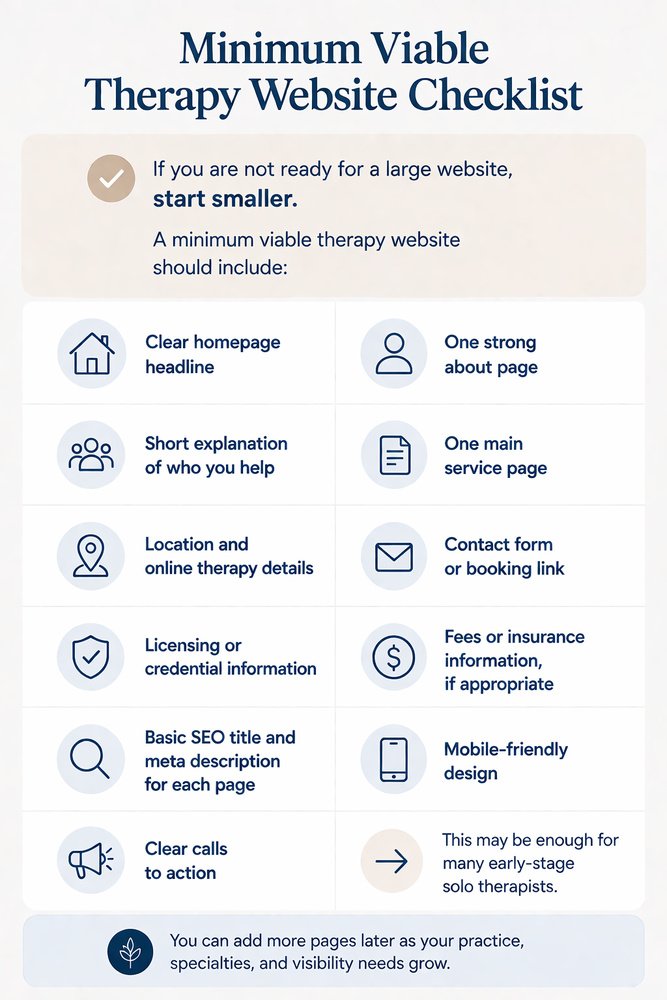
Minimum Viable Therapy Website Checklist
If you are not ready for a large website, start smaller.
A minimum viable therapy website should include:
Clear homepage headline
Short explanation of who you help
Location and online therapy details
One strong about page
One main service page
Contact form or booking link
Licensing or credential information
Fees or insurance information, if appropriate
Basic SEO title and meta description for each page
Mobile-friendly design
Clear calls to action
This may be enough for many early-stage solo therapists.
You can add more pages later as your practice, specialties, and visibility needs grow.
When a Therapist May Not Need a Large Website
Not every therapist needs a full custom website right away.
You may not need a large website if:
Your practice is full and you are not accepting new clients
You only accept referrals from a closed network
You are testing private practice before investing more deeply
You only need a simple professional presence for verification
You have one clear service and one clear audience
In those cases, a smaller site may be enough.
But even a small website should still be clear, accurate, and easy to trust.
A thin or outdated website can still create friction, especially when someone is already unsure about reaching out.
When to Redesign Your Therapy Website
It may be time to redesign your therapy website if:
It no longer reflects your practice
Your services or niche have changed
You avoid sending people to the site
The copy feels generic or outdated
The site is hard to use on mobile
You are getting traffic but few inquiries
Your directory profiles and website do not match
You want to improve SEO, local search, or AI visibility
The goal of a redesign is not just to make the site look better.
It is to make your practice easier to understand and easier to reach out to.
Therapy Website Checklist
Use this checklist to review your current site.
Clarity
Can someone understand who you help within a few seconds?
Are your services clearly named?
Does your homepage explain your practice in plain language?
Does your copy sound specific rather than generic?
Trust
Do you include credentials and licensing information?
Does your about page help people understand your approach?
Are photos current and professional?
Does the site feel calm and credible?
Conversion
Is the next step clear on every main page?
Are buttons easy to find?
Does the contact page explain what happens next?
Is the site easy to use on mobile?
SEO and Visibility
Do you have dedicated pages for key services?
Do your page titles include clear service and location language where appropriate?
Is your Google Business Profile aligned with your website?
Do you answer common client questions on your site?
Fit
Does the website reflect your current practice?
Would you feel comfortable sending a referral source to it?
Does it attract the kind of clients you want to work with?
If you answer no to several of these, the issue may not be one small fix. The site may need clearer structure, copy, and design together.
Need Help Building a Therapy Website That Reflects Your Practice?
Your website should feel like your practice.
Not generic. Not overly polished. Not disconnected from how you actually work.
At Designed By Thrive, I create websites for therapists and therapy practices that feel clear, thoughtful, and true to the work behind them. The focus is not just on how the site looks, but whether it helps potential clients understand your services, trust your approach, and take the next step.
If you'd like support creating a website that brings all of this together, please learn more about our therapist website design services.
Not getting enough therapy clients to your website?
In under 60 seconds, find out what your website is doing well, what might be holding you back, and whether your online presence is easy for potential clients, Google, and AI search tools to understand.
FAQ: Therapy Websites
Do therapists still need a website?
Yes, most therapists still benefit from having a website. A website gives potential clients a clearer place to understand your services, approach, location, credentials, and next steps outside of a directory or referral source.
Is Psychology Today enough for therapists?
Psychology Today can help with visibility, but it usually should not be the only online presence for a therapy practice. A website gives you more control over your message, services, SEO, and client journey.
What pages should a therapy website have?
Most therapy websites should include a homepage, about page, service pages, FAQ or getting-started page, and contact page. Group practices may also need clinician bios, location pages, and intake information.
What should a therapist website homepage include?
A therapist homepage should include a clear headline, who you help, your main services, your location or online therapy details, a brief introduction to your approach, and a clear call to action.
Do I need a big website if my therapy practice is full?
Not always. If your practice is full, a simple website may be enough to clarify your services, availability, waitlist, referral information, and professional credibility.
Can a website help therapists get more clients?
Yes, when it is clear, findable, and easy to use. A website can support SEO, referrals, directory traffic, and client decision-making before someone reaches out.
What makes a therapy website effective?
An effective therapy website helps potential clients understand who you help, what you offer, how therapy with you works, and how to take the next step. It also needs to be easy to use, mobile-friendly, and structured clearly for search engines.